


Apache Ossie: an introduction to the open semantic layer standard
What this open format describes, and a first model on the TPC-H orders data
Apache Ossie is an open format for writing your business metrics once, in a file every tool can read, directly or through a converter. We build a first model on order data, validate it with the official tooling, and let DuckDB compute it.
Contents
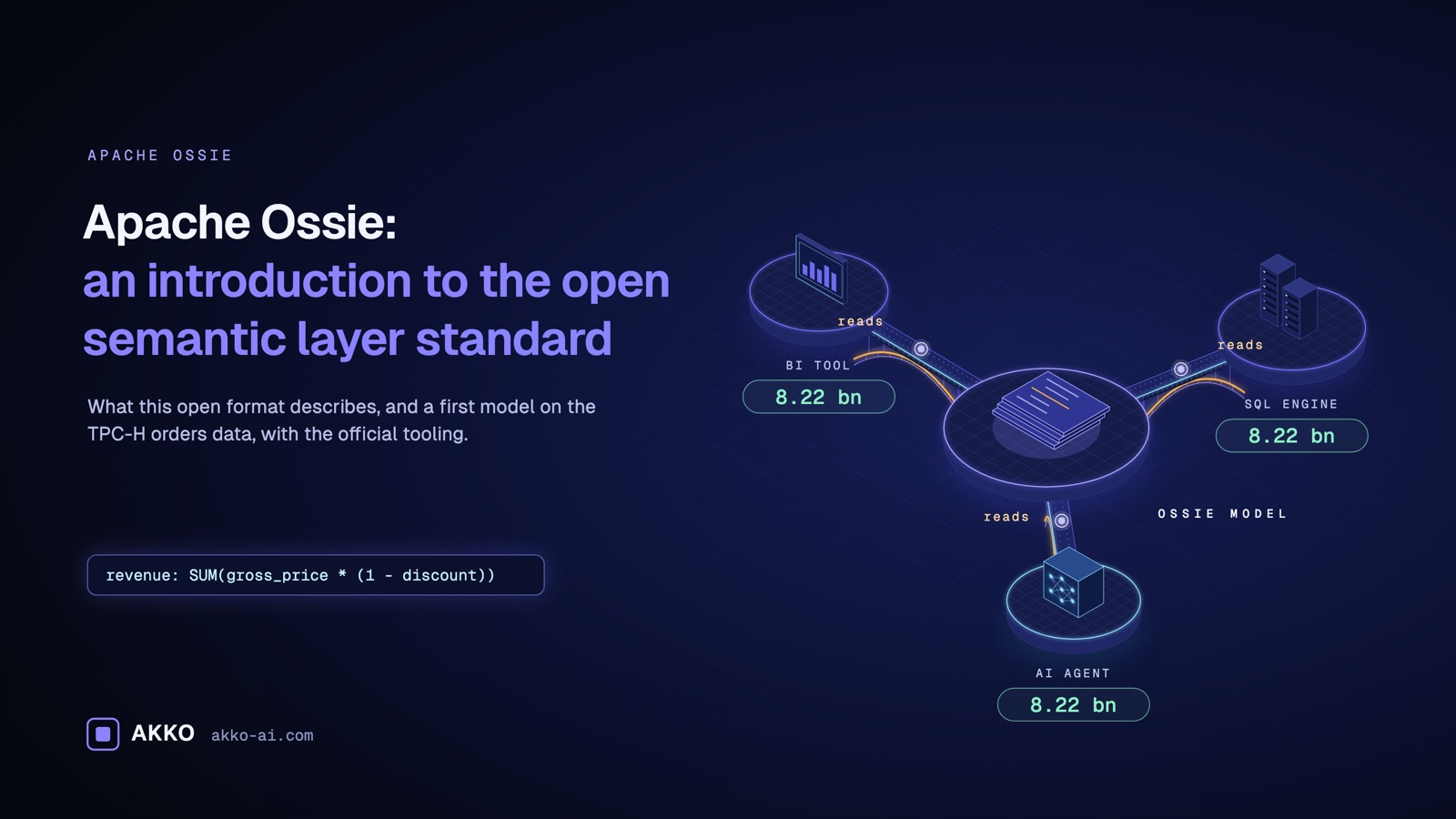
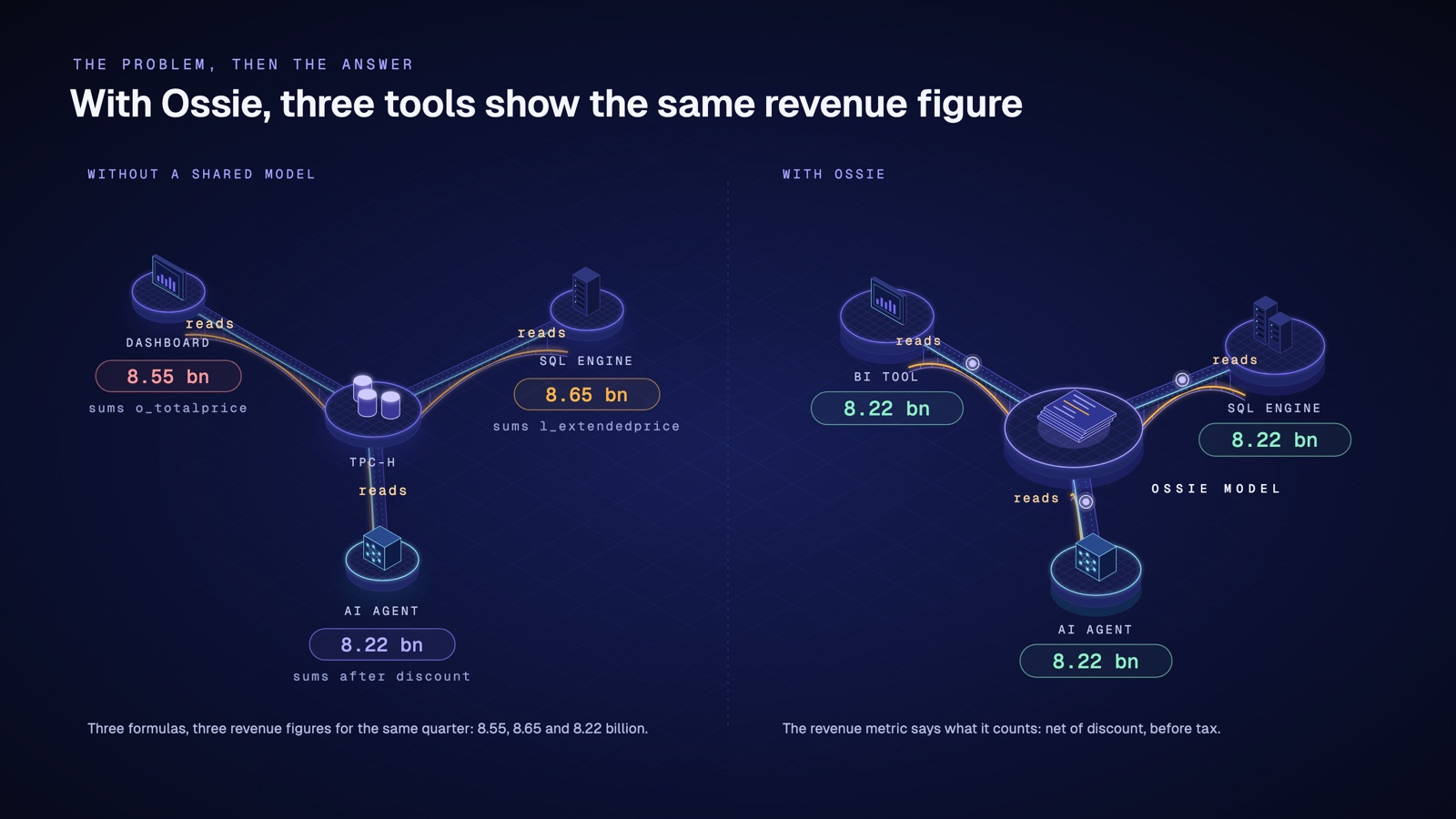
What was revenue in the first quarter of 1995? On the TPC-H orders data, the answer depends on which column you sum:
o_totalprice, the order total, gives 8.55 billion, tax included;l_extendedprice, the gross line price, gives 8.65 billion;- the same price minus each line’s discount gives 8.22 billion.
All three queries are valid, yet the highest and lowest answers are 433 million apart. In a real team, each formula lives in a different tool (a dashboard, a SQL engine, an AI agent), and nobody notices they disagree. With Apache Ossie, you write the definition once and every tool reads it.
What Ossie is
An Ossie model is a YAML or JSON file. It describes four objects:
- a dataset points to a table through its
sourcekey; - a field reads a column and gives it a business name, such as
gross_priceforl_extendedprice; - a metric is an aggregate calculation over fields;
- a relationship links two datasets through a foreign key.
Every expression is written in sql, in OSSIE_SQL_2026, the portable language the spec defines. A dialects list can add variants specific to one tool.
Here’s an excerpt from the model we’ll write, with one dataset, one field and one metric:
datasets:
  - name: line_items
    source: tpch.main.lineitem
    fields:
      - name: gross_price
        expression:
          sql: l_extendedprice
    metrics:
      - name: revenue
        expression:
          sql: SUM(gross_price * (1 - discount))
Ossie is neither an engine nor an access control system.
- It stores no data and computes nothing. Whatever reads the file (a BI tool, a SQL engine, an AI agent) translates each definition into its own SQL. The project publishes converters in the
apache/ossie-convertersrepository. - It defines metrics, but doesn’t say who’s allowed to see them.
The spec has four layers:
- Layer 1 defines the model format and its expression language;
- Layer 2 says how to query it in SQL, with
AGG(); - Layer 3 queries it with a list of dimensions, metrics and a filter, the spec itself fixing the joins;
- Layer 4 carries the ontology.
This tutorial only uses Layer 1.
Set up
You need Python 3.11 or later, git, about 400 MB of disk space, and macOS or Linux.
Get the code. The full model and both scripts are ready to download:
sales.ossie.yaml,prepare.py,compute.py, and every command incommands.sh.
Step 1 · Install the official tooling
The project repository holds the validator (a Python script) and the Python SDK that reads models. The spec changes from week to week, so we pin the repository to a commit. DuckDB will serve as both the database and the tool that computes the metrics.
$ git clone -q https://github.com/apache/ossie
$ git -C ossie checkout -q aa500d3
$ python3 -m venv .venv
$ source .venv/bin/activate
$ pip install -q sqlglot==30.31.0 jsonschema==4.26.0 pyyaml==6.0.3 duckdb==1.5.6 ./ossie/python
$ pip list | grep ossie
apache-ossie 0.3.0.dev0Step 2 · Generate the orders and measure the problem
DuckDB generates TPC-H with its tpch extension, so there is no data file to download. The script builds tpch.duckdb at scale factor 1 (one and a half million orders, six million lines), then computes the quarter’s revenue the three ways.
"""Generates the TPC-H data in a DuckDB database, then computes one quarter's revenue three ways."""
import duckdb

db = duckdb.connect("tpch.duckdb")
db.sql("INSTALL tpch; LOAD tpch; CALL dbgen(sf => 1)")
quarter = "o_orderdate >= DATE '1995-01-01' AND o_orderdate < DATE '1995-04-01'"
calculations = {
    "sum of o_totalprice": f"SELECT SUM(o_totalprice) FROM orders WHERE {quarter}",
    "sum of l_extendedprice": f"SELECT SUM(l_extendedprice) FROM lineitem JOIN orders ON l_orderkey = o_orderkey WHERE {quarter}",
    "same sum, after discount": f"SELECT SUM(l_extendedprice * (1 - l_discount)) FROM lineitem JOIN orders ON l_orderkey = o_orderkey WHERE {quarter}",
}
for label, query in calculations.items():
    print(f"{label:<26}{db.sql(query).fetchone()[0]:>18,.2f}")
$ python prepare.pysum of o_totalprice 8,545,777,729.15
sum of l_extendedprice 8,649,700,379.71
same sum, after discount 8,216,374,767.78Generating the data takes about ten seconds. The first time, DuckDB downloads the tpch extension, so you need internet access.
Each number counts something different. o_totalprice is the order total, tax included and discount taken off. l_extendedprice is a line’s price before discount. We keep the third definition, net of discount and before tax, and write it into the model.
Write the model
Step 3 · Describe the datasets and their fields
Create sales.ossie.yaml with three datasets: customers, orders and order lines. Only the model sees the TPC-H column names, such as l_extendedprice. The metrics use gross_price.
version: 0.3.0.dev0
name: sales
description: Customers, orders and order lines from the TPC-H dataset.
datasets:
  - name: customers
    source: tpch.main.customer
    primary_key: [customer_id]
    fields:
      - name: customer_id
        expression:
          sql: c_custkey
      - name: segment
        expression:
          sql: c_mktsegment
        dimension: {is_time: false}
  - name: orders
    source: tpch.main.orders
    primary_key: [order_id]
    fields:
      - name: order_id
        expression:
          sql: o_orderkey
      - name: customer_id
        expression:
          sql: o_custkey
      - name: order_date
        expression:
          sql: o_orderdate
        datatype: Date
        dimension: {is_time: true}
      - name: total_with_tax
        description: Order total, tax included and discount taken off.
        expression:
          sql: o_totalprice
        datatype: Decimal
  - name: line_items
    source: tpch.main.lineitem
    description: One row per item ordered.
    primary_key: [order_id, line_number]
    fields:
      - name: order_id
        expression:
          sql: l_orderkey
      - name: line_number
        expression:
          sql: l_linenumber
      - name: gross_price
        expression:
          sql: l_extendedprice
        datatype: Decimal
      - name: discount
        expression:
          sql: l_discount
        datatype: Decimal
      - name: return_flag
        expression:
          sql: l_returnflag
dimension: {is_time: false}- The primary key references the
order_idfield, not theo_orderkeycolumn. - The
dimensionblock carries the time role:is_timesays whether the field is a time axis. Without it, the spec infers that role from thedatatype, andDategives a time axis. Any field can be used to group by, but some tools, such as the Python SDK, only treat the fields that carry this block as dimensions. sqlis written inOSSIE_SQL_2026, which starts from SQL:2003 and adds common vendor functions such asIFForDATEADD. It’s the only language whose meaning the spec defines. An expression can also carry adialectslist, whose names are free-form: the project’s catalog, which is non-normative, lists nineteen, includingANSI_SQLandTRINO. Apart fromOSSIE_SQL_2026, the spec treats them as opaque, and a tool may ignore them. Ifsqland anOSSIE_SQL_2026entry both exist,sqlwins.
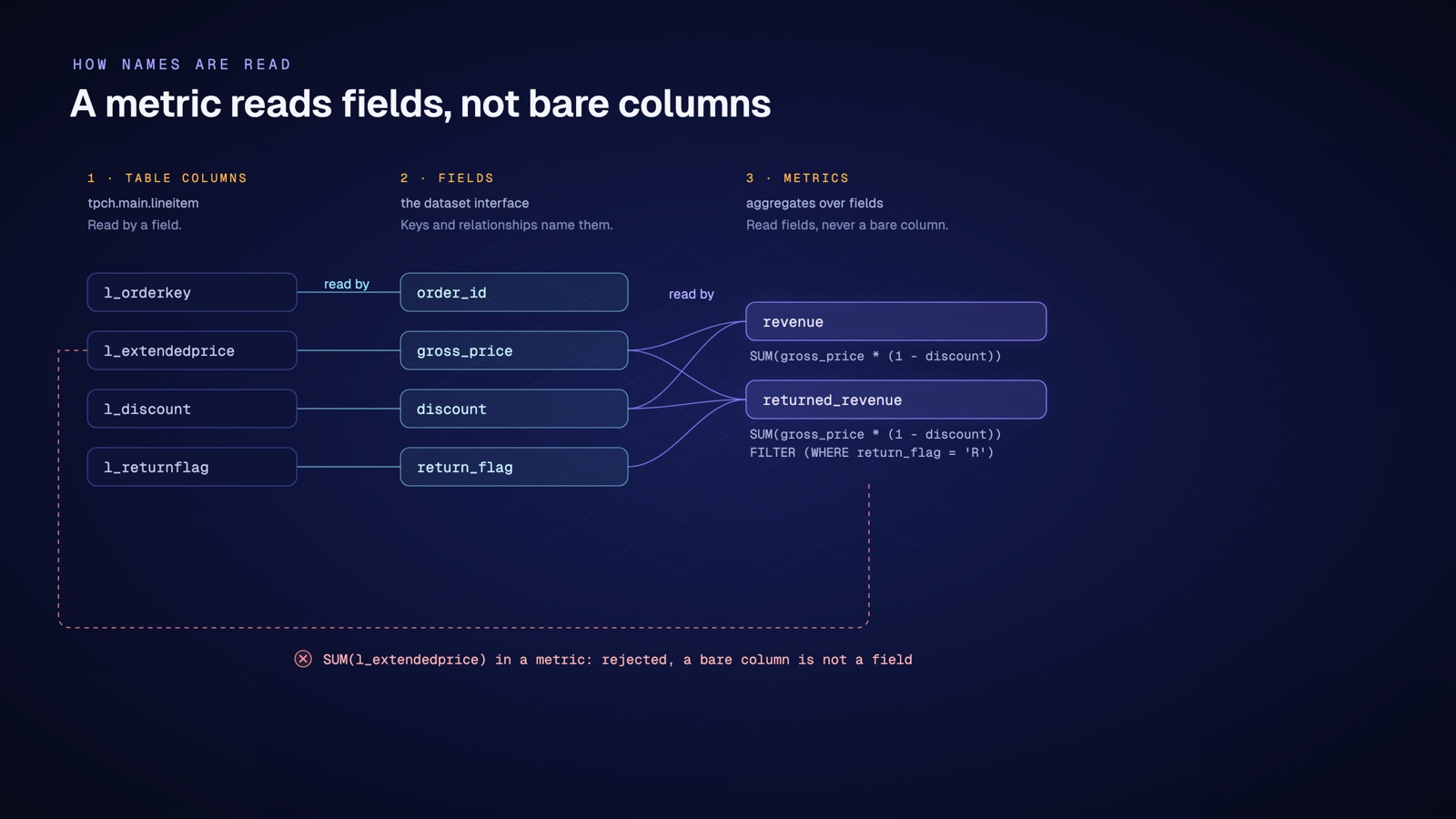
Three levels of names. The spec separates table columns, fields and metrics. A metric reads fields. It names a table column only in one specific form,
source.column, which we see in step 6.
Step 4 · Write revenue once
A metric that reads a single dataset is declared inside that dataset and uses the short names of its fields. That’s a dataset-level metric: it needs no join, so there is no join to choose. Append these lines to the file, indented by four spaces because they belong to line_items.
    metrics:
      - name: revenue
        description: Revenue net of discount, before tax.
        expression:
          sql: SUM(gross_price * (1 - discount))
        datatype: Decimal
        ai_context:
          synonyms: [sales, turnover, net revenue]
      - name: returned_revenue
        description: Revenue from lines the customer sent back.
        expression:
          sql: SUM(gross_price * (1 - discount)) FILTER (WHERE return_flag = 'R')
datatype: Decimal- The description of
revenuesettles the opening question: net of discount, before tax. ai_contextgives an AI agent synonyms, so it finds the metric when someone asks about “sales”.FILTER (WHERE ...)is part ofOSSIE_SQL_2026. Here it keeps only the returned lines.
There’s nothing to run here: the validator in step 6 reads these lines.
Step 5 · Link the datasets
In a relationship, from is the “many” side and to is the “one” side: an order has many lines, a customer has many orders. A metric that crosses a relationship is a model-level metric. It goes at the top level of the file, and every field in it is written as dataset.field, even when only one dataset has that name. Append these lines to the file, with no indentation.
relationships:
  - name: line_items_orders
    from: line_items
    to: orders
    from_columns: [order_id]
    to_columns: [order_id]
  - name: orders_customers
    from: orders
    to: customers
    from_columns: [customer_id]
    to_columns: [customer_id]
metrics:
  - name: avg_order_value
    description: Average revenue per order.
    expression:
      sql: AGG(line_items.revenue) / COUNT(DISTINCT orders.order_id)
datatype: Decimal- Despite their names,
from_columnsandto_columnsname fields. On thetoside, they must form the primary key or a unique key. AGG(line_items.revenue)reuses the metric from step 4: the revenue formula is written only once.AGGonly takes a dataset-level metric, writtendataset.metric, and noFILTER.- In
OSSIE_SQL_2026,/is true division:5 / 2is 2.5. An engine that truncates integer division, such as Trino, has to evaluate an equivalent expression, for example with aCASTtoDECIMAL.
Again, there’s nothing to run: the next step reads these lines.
Validate and compute
Step 6 · Validate the model
The official validator checks the structure against the JSON Schema, looks for duplicate names, resolves the names that keys, relationships and metrics refer to, and checks the SQL syntax.
$ python ossie/validation/validate.py sales.ossie.yamlValidation PASSED: sales.ossie.yamlA column instead of a field
We replace gross_price with the l_extendedprice column in the revenue metric. The validator rejects it.
$ sed '1,/SUM(gross_price/s/SUM(gross_price/SUM(l_extendedprice/' sales.ossie.yaml > column-test.yaml
$ python ossie/validation/validate.py column-test.yaml
Validation FAILED with 1 error(s):
[Scope] Dataset-scoped metric 'line_items.revenue' in model 'sales' (OSSIE_SQL_2026) references undeclared field(s) 'l_extendedprice'. A dataset-scoped metric may reference only the dataset's declared fields, and its source columns as source.column.The message gives the fix: name the table column as source.column.
$ sed '1,/SUM(gross_price/s/SUM(gross_price/SUM(source.l_extendedprice/' sales.ossie.yaml > source-test.yaml
$ python ossie/validation/validate.py source-test.yaml
Validation PASSED: source-test.yamlA qualified name such as line_items.gross_price is still rejected in a dataset-level metric.
A column in a relationship
A key or a relationship must name fields. Here, from_columns gets a table column.
$ sed 's/from_columns: \[order_id\]/from_columns: [l_orderkey]/' sales.ossie.yaml > relation-test.yaml
$ python ossie/validation/validate.py relation-test.yaml
Validation FAILED with 1 error(s):
[Reference] Relationship 'line_items_orders' in model 'sales': from_columns references undeclared field 'l_orderkey'. from_columns must be field names of the from dataset 'line_items'.An unqualified name
In the average order value, we write order_id without its dataset. The spec forbids it, but the validator only prints a warning.
$ sed 's/COUNT(DISTINCT orders.order_id)/COUNT(DISTINCT order_id)/' sales.ossie.yaml > name-test.yaml
$ python ossie/validation/validate.py name-test.yaml
[Reference] Warning: Metric 'avg_order_value' in model 'sales' (OSSIE_SQL_2026): 'order_id' is not qualified; metric expressions refer to fields as dataset.field
Validation PASSED: name-test.yamlThe warning is printed before the Validation PASSED line, and the exit code stays 0. In a script, read the output, not just the exit code. A column named in a model-level metric, such as line_items.l_extendedprice, also gets only a warning.
A variant for Trino
An expression can add a variant for one tool, next to sql. This command adds a TRINO entry to the gross_price field.
$ awk '{print} /^          sql: l_extendedprice$/ {print "          dialects:"; print "            - dialect: TRINO"; print "              expression: l_extendedprice"}' sales.ossie.yaml > trino-test.yaml
$ python ossie/validation/validate.py trino-test.yaml
Validation PASSED: trino-test.yamlTRINO has been in the dialect catalog since 30 October. The catalog is non-normative, and for the spec a TRINO expression stays opaque. The validator reads it as Trino SQL.
Step 7 · Compute the metrics as a tool would
Now we act as the tool. The script reads the model with the SDK, exposes each dataset’s fields in a subquery, then computes each dataset-level metric on DuckDB.
"""Computes the metrics of each dataset in an Ossie model, on a DuckDB database."""
import sys

import duckdb
from ossie import OssieDocument

model = OssieDocument.from_ossie_yaml(open(sys.argv[1]).read())
db = duckdb.connect(sys.argv[2])


def sql(expression):
    # `sql` is the portable form and wins. Without it, we read the OSSIE_SQL_2026 entry of dialects.
    if expression.sql:
        return expression.sql
    return next(d.expression for d in expression.dialects if d.dialect == "OSSIE_SQL_2026")


for dataset in model.datasets:
    # Fields are the dataset's interface: every metric reads them.
    # This script doesn't handle source.column, which the spec also allows in a dataset-level metric.
    fields = ", ".join(f"{sql(field.expression)} AS {field.name}" for field in dataset.fields)
    for metric in dataset.metrics or []:
        query = f"SELECT {sql(metric.expression)} FROM (SELECT {fields} FROM {dataset.source})"
        print(f"{dataset.name}.{metric.name} = {db.sql(query).fetchone()[0]}")
$ python compute.py sales.ossie.yaml tpch.duckdbline_items.revenue = 218102223885.0001
line_items.returned_revenue = 53741292684.6040- These numbers cover the full history, from 1992 to 1998: the script doesn’t filter.
- For the quarter, you filter on
order_date, which lives inorders, so you joinline_itemstoordersalongline_items_orders, as in step 2. Our script doesn’t join: that’s the job of an engine that implements the spec’s query layers.
Note. Layer 1 doesn’t say how to compute a metric that spans datasets: Layers 2 and 3 do. In Layer 2, the tool writes its own joins in SQL, and
AGG()evaluates each metric without double counting. In Layer 3, you ask for dimensions, metrics and a filter, and the spec fixes the choice of joins: a conforming engine rejects an ambiguous path instead of guessing. The quarter is requested like this:{"metrics": ["line_items.revenue"], "filter": "orders.order_date >= DATE '1995-01-01' AND orders.order_date < DATE '1995-04-01'"}.
A real tool also has to translate OSSIE_SQL_2026 into its own SQL, which this tutorial doesn’t do. The next article looks at the pitfalls of that translation on Trino.
What the spec leaves to each tool
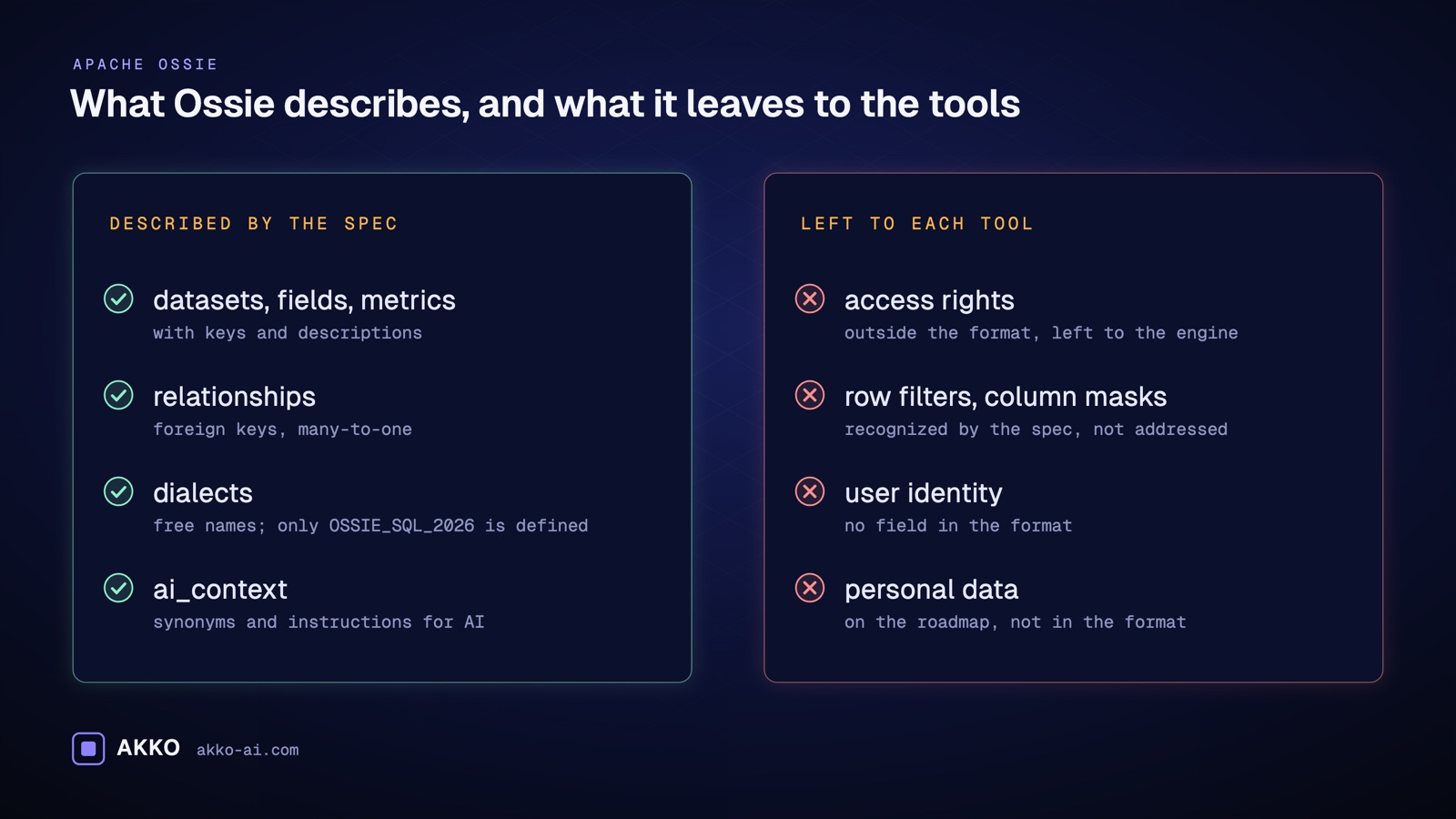
- Access rights, row filters and column masks. Layer 2 says their effect on metric evaluation is “recognized but not addressed”.
- Identity. No field ties a metric to a user or a group. The roadmap plans access control for models stored in a catalog, not for the data they describe.
- Personal data. The
contains_personal_dataandis_confidentialattributes are not part of the format. They remain on the roadmap (issue 58, issue 59).
If only finance should see your revenue figure, write that rule in the engine or the catalog.
Where the project stands
The project used to be called Open Semantic Interchange (OSI). It has been in the Apache Incubator since June 2026.
- There is no Apache release yet. The only version the spec history marks as released is 0.1.1, from December 2025, published under the former name. The version in development is 0.3.0.dev0, and the next planned release will be called 0.3.0-incubating. The spec warns that it may still change and advises against relying on it in production.
- The dialect name has been free-form since 26 October, and the portable expression is written in
sql.TRINOentered the non-normative catalog of dialects on 30 October. - Compared with 0.1.1, several changes break compatibility: a single model per document, placed at the top level of the file,
custom_extensionsrenamednonportable_extensions, and field names, no longer column names, in keys, relationships and metrics.
Key takeaways
- A loosely defined revenue metric allows several correct but incompatible answers: 433 million apart on our quarter.
- Metrics read fields, fields read columns. Write the formula in a dataset-level metric, then reuse it with
AGGin a model-level metric. - The validator rejects a bare column in a dataset-level metric, in a key and in a relationship. For an unqualified name in a model-level metric it only prints a warning: read its output.
- Ossie computes nothing and enforces no access rules: the tool translates, joins and controls access.
Test yourself
1. Does Ossie compute your metrics?
No. A tool reads the file, then computes with its own engine, the way our script does with DuckDB.
2. Why write orders.order_id rather than order_id in the average order value?
The average order value is a model-level metric: the spec requires dataset.field for every field, even without ambiguity. Here, order_id exists in both line_items and orders. The validator doesn’t reject the model, it prints a warning before Validation PASSED, but the model isn’t conforming.
3. Can a metric read the l_extendedprice column?
Not under that name. It reads the gross_price field. In a dataset-level metric you can also name the source column, written source.l_extendedprice; a bare column is rejected there. In a model-level metric, the spec forbids it too, but the validator only prints a warning.
Frequently asked questions
What is Apache Ossie?
An open format, in YAML or JSON, that describes a semantic model: datasets, fields, metrics and relationships. It lets BI tools, SQL engines and AI agents share the same definitions, such as the definition of revenue.
What is the current version of Ossie?
The only version the spec history marks as released is 0.1.1, from December 2025. The version in development is 0.3.0.dev0, unreleased: it may still change. The next planned release is 0.3.0-incubating. There is no Apache release yet.
How do I validate an Ossie model?
With the validation/validate.py script from the apache/ossie repository. It rejects a bare column in a dataset-level metric, in a key and in a relationship. For a doubtful reference in a model-level metric, it only prints a warning.
Is Trino a dialect of Apache Ossie?
TRINO has been in the project's dialect catalog since 30 October 2026. The catalog is non-normative. The spec only defines OSSIE_SQL_2026, and a TRINO expression is opaque to it. The official validator checks its syntax as Trino SQL.
Does Ossie handle access rights on metrics?
No. The spec describes no access rights, no identity and no filtering of rows by user: it recognizes the subject without addressing it. Those rules stay in the engine and the catalog.